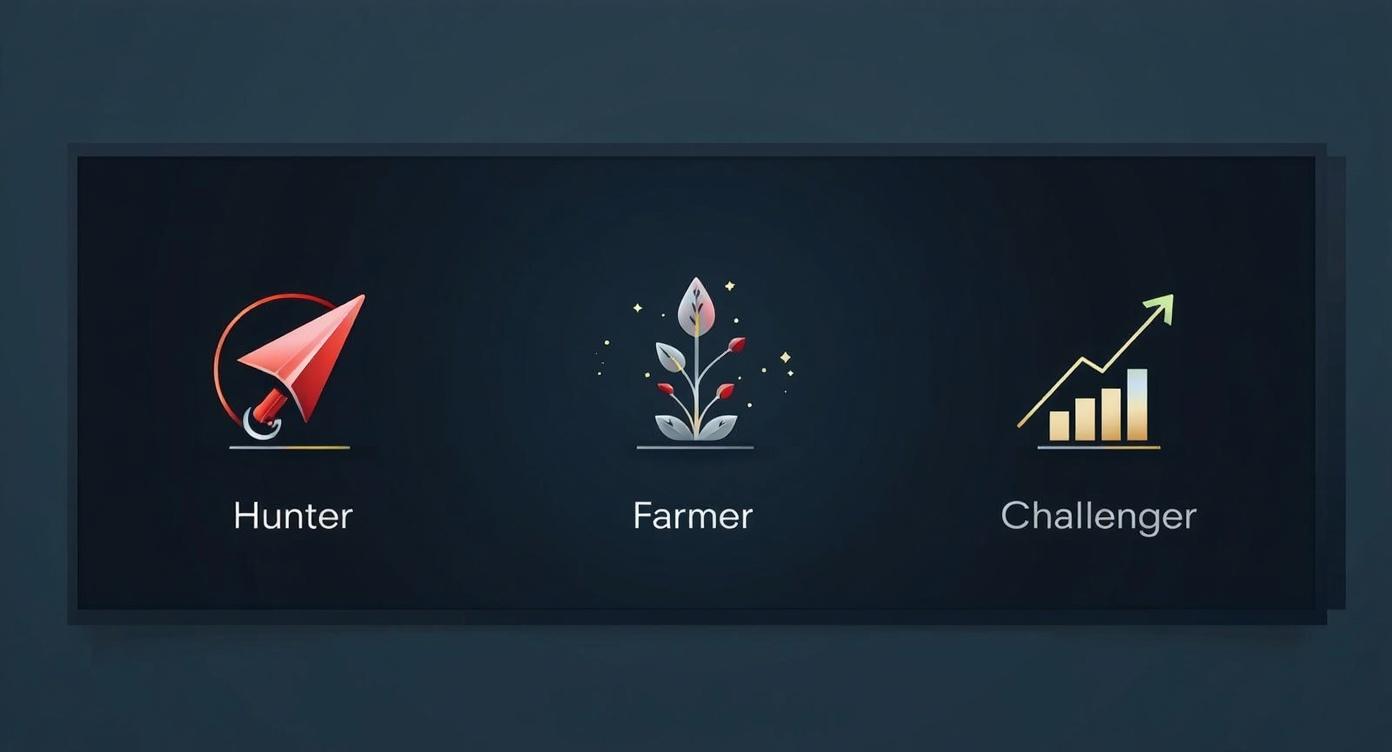
You're hiring salespeople with the wrong profile. And that's why that top performer from their previous company is flopping on your team.
Every week I get the same question from founders: "Caca, I need to hire a salesperson. Do you know any good hunters?"
My answer usually frustrates them: "It depends. Does your operation actually need a hunter?"
Because here's the inconvenient truth: there's no "best sales profile." There's the right profile for the type of sale you need to close.
And when you get this match wrong, the result is predictable: frustrated salesperson, stagnant targets, founder burning cash on turnover.
Let's fix this today.
The Three Archetypes (and What Nobody Tells You About Them)
Hunter: The New Business Chaser
What it is: A salesperson specialized in active prospecting and opening new clients. Lives for the hunt, not the harvest.
Behavioral DNA:
- High rejection tolerance (makes 100 calls and doesn't flinch at 95 "nos")
- Motivated by conquering new territories
- Gets bored quickly with long-term relationships
- Extremely competitive (wants to be the first to close that impossible prospect)
- Terrible at post-sale follow-up or account management
The classic mistake: Hiring a hunter and expecting them to do post-sales, upselling, or client care after closing. They'll drop the ball — not due to incompetence, but because it literally kills their soul.
When it works:
- Virgin market or new category (nobody knows your solution)
- Short to medium sales cycle (up to 90 days)
- Product with clear fit and replicable process
- You have structure to take over the client after closing
When it fails:
- Complex product requiring prolonged consulting
- Saturated market where relationship > cold prospecting
- Your operation depends on account expansion (land & expand)
- You don't have CSM/Account Manager to receive the client
Farmer: The Account Cultivator
What it is: A salesperson specialized in cultivating relationships and expanding revenue within existing accounts.
Behavioral DNA:
- Strategic patience (plants today, harvests in 6 months)
- Ability to map stakeholders and build internal champions
- Focus on LTV (lifetime value) > quick commission
- Excellent at identifying upsell/cross-sell opportunities
- Struggles with cold prospecting (prefers cultivating who they already know)
Insight: Farmers are responsible for 80% of recurring revenue in mature SaaS companies. But founders in early traction ignore them because they "don't bring new clients."
When it works:
- Land & expand model (starts small, grows within the account)
- Product with multiple modules or use cases
- Average ticket allows expansion (from $1k/month to $10k/month)
- High churn hurts more than slow acquisition
When it fails:
- Empty pipeline (can't cultivate what doesn't exist)
- Commoditized product with no expansion opportunity
- One-time transaction market (no long-term relationship)
- Company in fit discovery phase (needs to test fast, not cultivate slowly)
Challenger: The Salesperson Who Challenges the Status Quo
What it is: Profile popularized by the book "The Challenger Sale" (Matthew Dixon & Brent Adamson). A salesperson who teaches, provokes, and reconstructs the client's view of the problem.
Behavioral DNA:
- Comfortable challenging client beliefs (without being arrogant)
- Deep mastery of the problem > product features
- Ability to articulate insights the client didn't have
- Assertive in taking control of the sales conversation
- Less effective in simple transactional sales
Why Challenger became trendy: In complex B2B markets, the modern buyer has already researched 60-70% before talking to sales. If you just answer questions, you've become a walking FAQ. The Challenger brings perspective that Google doesn't have.
When it works:
- Complex sale with multiple stakeholders
- Disruptive solution or non-obvious category
- Client needs to be educated about the real problem
- Decision involves organizational change (switching legacy system, restructuring process)
When it fails:
- Self-service product or quick adoption
- Already educated market (everyone knows they need CRM, no need to "challenge" that)
- Buyer persona is technical who wants spec sheet, not strategic insight
- You don't have content/data to sustain the provocation (Challenger without substance = pretentious)
The Decision Framework: Which Profile for Which Operation?
Use this matrix to map the ideal profile:
| Scenario | Ideal Profile | Why? |
|---|---|---|
| Early-stage startup (seeking PMF) | Hunter + Founder selling | Need volume of conversations to validate fit. Farmer is premature luxury. Challenger requires playbook you don't have yet. |
| SaaS product with freemium | Farmer | Users already entered on their own. Challenge is converting trial→paid and expanding usage. |
| Complex enterprise solution (6+ months cycle) | Challenger | Buyer has status quo bias. Needs to be provoked to see cost of not changing. |
| Saturated market (10+ competitors) | Challenger | Differentiation via insight > feature. Pure hunter becomes commodity. |
| Product with network effects | Farmer | Value grows with internal adoption. Departmental expansion > new logo. |
| Blue ocean market (new category) | Hunter | Virgin territory. Whoever prospects fastest wins. |
| Churn above 15% annually | Farmer (urgent) | Leaky bucket. Fix retention > accelerate acquisition. |
| Average ticket >$20k/year | Challenger | Decision requires robust ROI. Strategic provocation justifies investment. |
Real Cases: When the Wrong Profile Sinks the Operation
Case 1: The Hunter Who Became the Bottleneck
Company: Management SaaS for SMBs, $150/month ticket
What they did: Hired 3 hunters to scale acquisition
Result after 6 months: 120 new clients, 22% churn, stagnant MRR
What happened: Hunters closed any prospect who signaled interest (even without fit). Nobody did structured onboarding or follow-up. Clients canceled within 90 days.
The fix: Hired 1 farmer for every 2 hunters. Farmer took over client on day 1, did onboarding, mapped expansion. Churn dropped to 8% in 4 months. MRR started growing for real.
Case 2: The Challenger Without Ammunition
Company: B2B analytics platform
What they did: Hired senior salesperson with Challenger Sale background
Result after 3 months: 0 deals closed, frustrated founder
What happened: Salesperson tried to "challenge" prospects with insights... but the company had no cases, market benchmarks, or proprietary data to sustain the provocation. It became bar talk.
The fix: Founder created "teach before sell" playbook: educational webinar, free diagnostic with industry data, whitepaper on hidden costs. Challenger now had what to challenge with. Closed 3 deals in the next 2 months.
Case 3: The Farmer Thrown Into the Jungle
Company: Martech startup in early traction
What they did: Hired farmer to "structure long-term relationships"
Result: Excellent salesperson... with nobody to cultivate (empty pipeline)
What happened: Founder expected farmer to also prospect. Farmer froze (it's not their DNA). Company burned 6 months of salary with no results.
The fix: Reallocated farmer to Customer Success (where they shined doing upsells on existing clients). Hired hunter to open pipeline. Doubled ARR in 8 months.
What If You Can Only Hire 1 Salesperson?
This is the reality for most early-stage founders. You don't have the luxury of building a dream team. You need to choose.
Golden rule: Hire for the most critical bottleneck today, not for tomorrow's dream operation.
Decision flowchart:
- Do you have qualified pipeline (20+ active prospects)?
- YES → Need to close. Hire Hunter or Challenger (depends on complexity).
- NO → Jump to #2.
- Do you have customer base with expansion potential (50+ active accounts)?
- YES → Need to retain and expand. Hire Farmer.
- NO → Jump to #3.
- Is your sales cycle >90 days and involves market education?
- YES → Hire Challenger (but prepare supporting content first).
- NO → Hire Hunter.
Red flag: If you're hiring "because everyone says you need a salesperson," stop. First figure out which type of salesperson solves which problem in your operation. Otherwise you'll burn cash and blame the salesperson for a casting error that was yours.
How to Identify Each Profile in the Interview
Theoretically every candidate will sell themselves as a "hybrid who does everything." In practice, DNA doesn't lie. Use these questions:
To Detect Hunter:
"Tell me about a client you won from scratch, where nobody knew you."
- Real hunter: Enthusiastically recounts prospecting strategy, how many attempts they made, how they got past the gatekeeper.
- Disguised farmer: Talks about a case where "someone referred me" or "they had already heard of the company."
To Detect Farmer:
"Which client did you expand the most? How did you identify the upsell opportunity?"
- Real farmer: Describes stakeholder mapping, approach timing, how they built champions.
- Disguised hunter: Generic answer like "I always asked if they needed more."
To Detect Challenger:
"Give me an example of a client who was convinced of the wrong solution. How did you change their perspective?"
- Real Challenger: Recounts how they articulated insights, data, or frameworks that triggered a shift in the conversation.
- Disguised order-taker: "Oh, I just explained the product features better."
The Truth Nobody Wants to Hear
Yes, bad salespeople exist. Let's be honest: some people simply don't have the skills, energy, or resilience that B2B sales requires.
But most cases of "bad salesperson" are actually wrong casting.
That hunter you fired for "not taking care of clients"? Maybe they really aren't cut out for sales. Or maybe they're an excellent hunter thrown into an operation that needs a farmer.
That farmer you thought was "too slow"? Maybe they really are slow. Or maybe you're demanding prospecting speed from someone whose talent is cultivating relationships.
That Challenger you thought was "arrogant"? Could be lack of emotional intelligence. Or could be an exceptional seller selling to buyers who just want a simple solution, not a strategic debate.
Before concluding the salesperson is bad, rule out casting error.
Because firing and hiring costs $100-150K between salary, commission, ramp time, and lost opportunity. If the problem is wrong match — not skill — you'll repeat the mistake with the next hire.
And wrong casting is expensive: 6 months salary + commission + opportunity cost of not having the right person in the right place.
So, Which Profile Does Your Operation Need?
If you got this far expecting me to say "hire Challenger, it's the best," sorry to disappoint.
The answer is: it depends.
It depends on your stage. Your product. Your market. Your current bottleneck.
But now you have the framework to decide with clarity instead of copying what company X did (which is probably in a completely different context from yours).