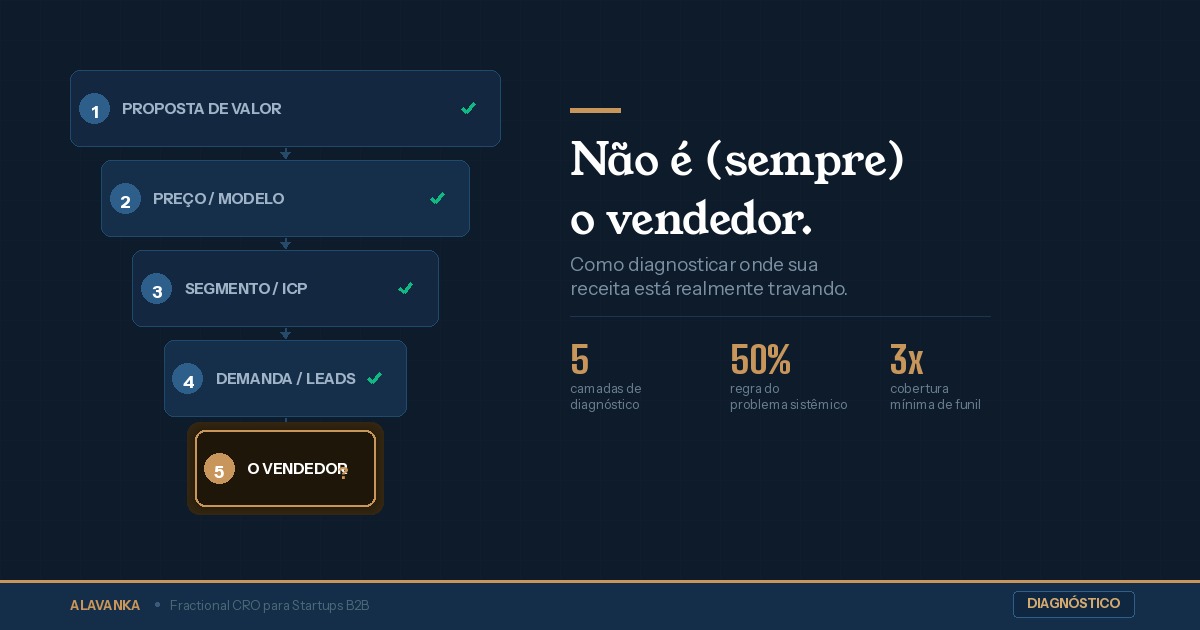
Revenue has stalled. The board is pressing. Your instinct says replace the rep. But that decision costs $100K to $150K between recruiting, training, and lost deals — and if the problem isn't the rep, the cycle restarts with the next hire. This article is the framework for making that decision with evidence, not with pressure.
In my experience structuring revenue operations, the most destructive pattern isn't firing too late. It's firing without diagnosing. Every month of delay costs pipeline, team morale, and operational credibility. But every wrong termination costs double.
The most expensive decision in sales isn't firing too late. It's firing without knowing if the problem was actually the rep.
The Real Cost of the Wrong Decision
Before discussing when to make the change, let's size what's at stake.
These numbers reveal a dilemma: replacing too quickly burns cash and pipeline. Replacing too slowly burns morale and opportunity. The cost of keeping the wrong rep for one extra quarter can exceed the replacement cost — in lost deals, contaminated pipeline, and impact on the rest of the team.
First: Rule Out the System
This is the step most founders skip — and the most important one. Before evaluating the rep, you need to be certain the environment they operate in is working. If the system is broken, replacing the rep is like changing the driver when the car has no gas.
If more than 50% of the team is missing quota, stop. The problem isn't individual — it's systemic. Don't move to individual evaluation without addressing this first.
Walk through these 4 layers quickly. If any is compromised, fix it before evaluating the individual.
Ruled out all 4 layers? The team generally performs, resources are comparable, and the rep has been onboard for 6+ months? Now — evaluate the individual.
The 4 Types of Rep Gap
Identifying the gap type is critical because the response changes radically. Treating a skill gap as a will gap (or vice versa) wastes time and burns the relationship.
| Type | Symptoms | What to Do |
|---|---|---|
| Skill | High activity, low conversion. Books meetings but doesn't advance deals. Loses at negotiation or proposal stage. | Trainable. Intensive coaching for 60-90 days with a senior rep. |
| Will | Low activity, empty pipeline. Avoids prospecting. Doesn't follow up. Shows no urgency. | Direct conversation. 60-day improvement plan. If no change in 30 days, it likely won't change. |
| Fit | Performed well in a different context. Reasonable activity, but profile doesn't match the segment. E.g.: enterprise rep selling to SMBs. | Reposition internally if possible. If not, respectful separation. |
| Context | Performance dropped after a change (new territory, new product, new manager). Previously performed well. | Restore conditions or allow adaptation time. Not a separation candidate — yet. |
Skill gap is the most frequent and the most responsive to training. Studies show consistent individual coaching generates 19-32% improvement in conversion rates. Before giving up on this rep, ask: did we offer real coaching, or just pressure for results?
Metrics That Matter
Don't base the decision on quota attainment alone. Compare these metrics for the rep in question against the rest of the team:
- Activity: Volume and consistency of calls, emails, meetings booked
- Pipeline generated: Volume and quality of deals created
- Stage conversion rate: Where exactly do deals die? First meeting? Proposal? Negotiation?
- Cycle velocity: How long from first contact to close?
- Average deal size: Are they closing smaller contracts than the team?
- Forecast accuracy: Does what they project actually materialize?
A rep with high activity and strong pipeline but low conversion has a skill gap. A rep with low activity and an empty pipeline has a will gap. The response is radically different.
The Decision Tree: Train, Reposition, or Let Go
🌳 The Decision Framework
Has the rep been at the company for less than 6 months?
→ Adjust expectations. Evaluate leading indicators (activity, pipeline created), not final results. Reassess in 90 days.
→ Continue to Question 2.
Are more than 50% of the team also missing quota?
→ STOP. Systemic issue. Go back to the "Rule Out the System" section above. Also read: The Math Behind Sales Quotas.
→ Continue to Question 3.
Has the rep received structured coaching and clear feedback?
→ Continue to Question 4.
→ Implement a structured improvement plan (60-90 days). Don't let someone go without genuinely investing first.
What type of gap is it?
→ Final attempt: focused 60-day plan with specific metrics and weekly check-ins. If no improvement, let go.
→ Will gap without improvement = separation. Fit gap = try repositioning. If not possible, let go.
The Improvement Plan That Works (and the One That's a Sham)
Improvement plans have a terrible reputation — and for good reason. At most companies, they're pre-termination formalities with unrealistic goals and no real support. Reps even call them "paid interview period." A well-designed plan is different: it's a genuine diagnostic and development tool.
| Element | Effective plan ✅ | Performative plan ❌ |
|---|---|---|
| Duration | 60-90 days (compatible with the sales cycle) | 30 days (impossible in complex sales) |
| Goals | Leading indicators (activity, pipeline, meetings) + outcomes | Only final quota ("close $500K in 30 days") |
| Support | Weekly coaching, joint work with senior rep | None — "figure it out" |
| Check-ins | Weekly with specific, documented feedback | Only at the end of the period |
| Tone | Collaborative ("let's solve this together") | Punitive ("improve or leave") |
| Consequences | Clear from day one, no surprises | Vague or inconsistent |
Most end in separation. But the best sales leaders use the process for two things: giving the rep a real chance to turn things around, and documenting that the company did everything it could. Both matter — for the rep and for the company.
Improvement Plan Template (60 Days)
Weeks 1-2: Joint diagnosis. Identify specific gaps. Define 3-5 improvement metrics (e.g.: increase qualified meetings from 4 to 8/month, improve first-meeting-to-proposal conversion from 30% to 45%). Align support resources.
Weeks 3-4: Execution with intensive coaching. Weekly check-in. Joint calls with a senior rep on at least 3 meetings. Pipeline review with manager.
Weeks 5-6: Midpoint assessment. Is there progress? If no improvement in leading indicators — honest conversation about next steps.
Weeks 7-8: Final assessment. Have metrics improved? If yes, transition to ongoing coaching. If not, separation with respect and clarity.
Clear Signals: Time to Act
Even with the framework, sometimes the answer is more straightforward than it appears.
🔴 Time to let go
- Zero motivation: Activity doesn't improve after direct, repeated feedback
- Negative team impact: Complains publicly, sabotages processes, poisons culture
- Never takes ownership: There's always an external excuse for every missed target
- Inflated pipeline: Projects deals that will never close to appear productive
- Resistant to feedback: Doesn't implement guidance. Keeps the same patterns
- 3+ consecutive quarters below 50% of quota with adequate support
🟢 Time to invest
- Leading indicators improving: Activity and pipeline growing, even if revenue hasn't yet
- Receptive to feedback: Actively implements guidance, asks questions, practices, adjusts
- Recent context change: Territory, product, or management changed. Needs time
- Track record of results: Performed well before. Something specific changed
- Contribution beyond sales: Even without hitting quota, adds value through culture, mentoring, or process
- Deals in pipeline with real progress: Not volume — quality and advancement
How to Handle the Separation
When the diagnosis and improvement plan confirm it's time, how you handle the process matters as much as the decision itself.
- Before the conversation: Prepare all documentation, calculate severance, set the date. Align with legal. Have the pipeline transition plan ready — who takes over each deal.
- The conversation: Be direct, respectful, and brief. This isn't the time to relitigate performance. If the process was well-conducted, it shouldn't be a surprise.
- Pipeline transition: Assign an owner for each deal. Proactively communicate with clients. Complete the transition within 48 hours.
- Team communication: Be honest without exposing details. Don't badmouth, don't reveal individual performance. Focus on the transition plan.
The Complete Framework
| Phase | Duration | Action | Outcome |
|---|---|---|---|
| 1. Rule out system | 1-2 weeks | Walk through 4 layers: value prop, pricing, segment, demand | Confirm the problem is individual |
| 2. Diagnose gap | 1-2 weeks | Identify type: skill, will, fit, or context | Tailored prescription |
| 3. Coaching | 30 days | Intensive training + documented weekly feedback | Improvement or escalation to formal plan |
| 4. Improvement plan | 60 days | Clear goals, real support, defined consequences | Recovery or decision to let go |
| 5. Decision | 1 week | Final assessment + separation or reintegration | Closure for both parties |
Total timeline: ~90-120 days from first signal to outcome. That's not slow — it's diligent.
Conclusion
Most founders I work with arrive with the same frustration: "my rep isn't performing." In more than half of cases, after working through the diagnosis, the problem wasn't the rep — it was an unclear value proposition, misaligned pricing, a poorly chosen segment, or insufficient demand.
But when it is the rep — and sometimes it is — the framework ensures the decision is based on evidence, preceded by genuine investment, and executed with respect for the professional and the operation.
The most expensive mistake isn't the decision itself. It's making the decision without knowing what's actually causing the problem.