The program is designed. Tiers are defined, the contract signed, the partner onboarded. Now what? If the answer is "wait for the partner to start selling," the program just died — it just doesn't know it yet. Channel operations is what turns structure into pipeline. And most B2B companies skip this step entirely.
From concept to operations — each post builds on the previous. Best read in order.
- Post 1 — What it is, what it isn't, and why most get it wrong
- Post 2 — How to structure: criteria, tiers and value proposition
- Post 3 — How to operate: enablement, deal registration and governance (you are here)
- Post 4 — How to scale: recruiting, qualifying and compensating partners
Structure without operations is a contract in a drawer
When I built channel programs at Oracle and Informatica, the first thing I did — before recruiting a single partner — was design the GTM with surgical clarity: which accounts were strategic and would remain under direct sales, and which accounts had significant short-term potential and should be proactively worked by the channel.
That territorial definition wasn't a suggestion. It was the foundation of the entire operation. Without it, the conflict between direct and indirect isn't a question of "if" — it's "when." And when it arrives, it destroys trust faster than any commission structure can rebuild.
A channel program without defined operations is a collection of signed contracts that nobody executes. Structure says what the program is. Operations determine whether it works.
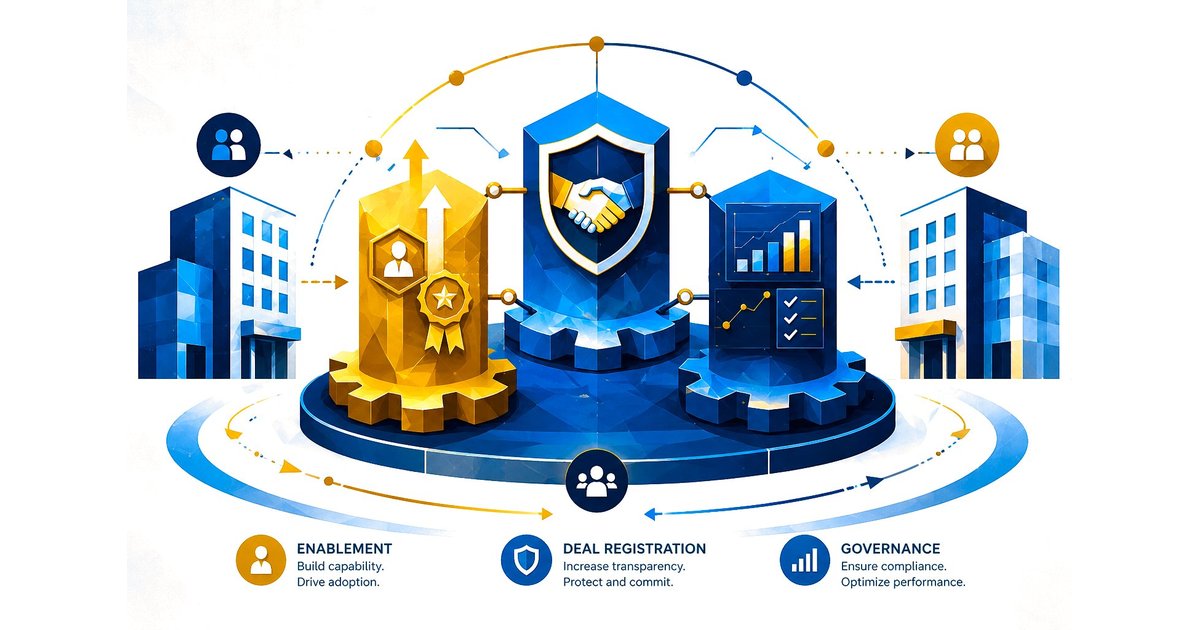
This post covers the three pillars of channel operations: how to transfer GTM to the partner (enablement), how to protect opportunities without creating bureaucracy (deal registration), and how to govern the program with data — not goodwill.
Pillar 1 — Enablement: transfer the GTM, not the slide deck
Channel enablement isn't sending the product deck and hoping the partner figures it out. It's the structured transfer of selling capability — from positioning to process, from pitch to objection handling.
What real enablement includes
Treating enablement as an event — a 2-day workshop and "good luck." Enablement is a continuous process. The market shifts, the product evolves, competitors move. If enablement stopped, the partner is selling with outdated information. And losing deals they should win.
Enablement as a tier criterion
A practice I implemented successfully: linking enablement level to the partner's tier. Silver partners need basic training and 1 certified professional. Gold requires advanced training and 2+ certified staff. This creates a natural incentive — the partner invests in enablement because the return (margin, leads, priority support) scales with it.
If you structured your tiers in Post 2 of this series →, linking enablement to tier is the natural bridge between structure and operations.
Pillar 2 — Deal registration: protect without bureaucratizing
Deal registration is the mechanism that protects the partner who sourced the opportunity. Without it, the partner has no incentive to invest in prospecting — because any lead they generate can be "stolen" by the direct team or another partner.
How it works in practice
1. The partner registers the opportunity — company, contact, estimated value, timeline. Simple form, no more than 5 fields.
2. The vendor approves or rejects within 48 hours — rejection requires justification (e.g., active opportunity already exists with direct team). No response within 48h = auto-approved.
3. Opportunity protected for 90 days — during this period, no other partner or direct rep can work the same account for the same product. Renewable once with documented progress.
4. Expiration with notice — automatic notification 15 days before expiration. If no documented progress, the opportunity returns to the pool.
If the vendor rejects a deal registration and then closes the deal with the same client via direct team within 90 days, the partner receives the full commission. No exceptions. Violating this rule once destroys trust across the entire ecosystem — and partners talk to each other.
When conflict is inevitable — territory rules
At Oracle, before opening the program to partners in a region, I defined with surgical clarity which accounts were strategic — where the direct rep led — and which accounts the partner should proactively generate opportunities for, because they had significant short-term potential.
The key isn't just defining territories. It's anticipating the transition rules that will inevitably be needed.
| Account moves from channel → direct | Quarter 1 | Quarter 2 | Quarter 3 | Quarter 4+ |
|---|---|---|---|---|
| Partner | 100% | 50% | 25% | 0% |
| Direct rep | 10% | 50% | 75% | 100% |
| Account moves from direct → channel | Quarter 1 | Quarter 2 | Quarter 3 | Quarter 4+ |
|---|---|---|---|---|
| Direct rep | 100% | 50% | 25% | 0% |
| Partner | 10% | 50% | 75% | 100% |
| Scenario | Rule | |||
|---|---|---|---|---|
| Deal registered by partner, closed via co-sell | Partner receives full commission — the registration is theirs | |||
The logic is simple: if the company decides to move an account from channel to direct, and that account closes in the first quarter after the change, the result came from the partner's work — not the direct team. That's why 100% of the commission goes to the partner. But the direct rep receives 10% from the start — because it's essential they're incentivized to help close the deal from day one of the transition, not just when the account "becomes theirs." The second quarter equalizes at 50/50 as both are contributing. From the fourth quarter onward, the transition is complete.
This table needs to be in the contract from day one — as we discussed in how to structure the program →. Without a written rule, every territory change becomes a negotiation. And negotiation without rules becomes conflict.
Pillar 3 — Governance: data, QBRs and knowing when to end it
Channel governance isn't micromanagement. It's the discipline of measuring, reviewing and acting based on evidence — not impression.
The metrics that matter
If 60% of your partners haven't registered a single deal in 90 days, you don't have a channel — you have a contact list. Activation rate below 40% signals that enablement failed, the value proposition isn't clear, or the wrong partners were selected. Review the fundamentals from Post 1 → before recruiting more partners.
QBR — Quarterly Business Review
A QBR with a partner isn't ceremony. It's the most important session in the program — where data becomes decisions.
When to end a partnership
At Informatica, I had a partner responsible for Mexico who consistently couldn't generate business. I conducted multiple territory reviews — sessions that were frustrating for everyone involved. But because they were focused on data and conducted pragmatically, after several sessions we reached the conclusion together that continuing the partnership didn't make sense.
The partner received the decision naturally. We closed the partnership while maintaining a positive relationship — which matters, because in the B2B world, today's partner can be tomorrow's client.
When to end the partnership?
Has the partner generated pipeline in the last 2 quarters?
→ Evaluate win rate and quality. If pipeline exists but doesn't convert, the problem may be enablement, not the partner.
→ Next question.
Has the partner completed enablement and achieved certification?
→ Structural problem. The partner's market may not fit your ICP. Discuss territory and evaluate exit.
→ Require completion within 30 days. If they don't complete it, exit. A partner who won't invest in training won't invest in selling.
Ending a partnership doesn't have to destroy a relationship. If reviews were data-driven, the partner knows results aren't coming — often before you say it. The final conversation is a formality, not a surprise. Keep the communication channel open. In B2B, the market is smaller than it seems.
The complete operating model
The three pillars feed each other: enablement generates capability, deal registration protects the opportunity, governance ensures the system works over time.
| Pillar | Without operations | With operations |
|---|---|---|
| Enablement | Partner gets a deck and "figures it out." Sells what they know, not what you need. | Certified partner runs the deal independently. Co-sell only on complex deals. |
| Deal Registration | Constant conflict between direct and indirect. Partner stops prospecting. | Protected opportunity, clear rules, trust preserved. |
| Governance | Gut-feel decisions. Inactive partners accumulate. Program loses credibility. | Data-driven QBRs, evidence-based tier decisions, exit with dignity. |
Conclusion: operations is where the program lives or dies
Structure is necessary — and we covered it in depth in Posts 1 and 2 of this series. But structure without operations is architecture without an occupant. Enablement gives the partner the ability to sell. Deal registration gives them confidence to invest in prospecting. And governance ensures the program evolves, corrects course, and — when necessary — ends partnerships that aren't delivering results.
The next and final post in this series covers the step that comes after operating: how to scale the channel — recruiting new partners, qualifying them efficiently, and structuring compensation so incentives align with results.
A channel that works isn't the one with the most partners. It's the one where every partner knows exactly what to do, has protection to do it, and is held accountable with data — not pressure.
Post 4 — How to scale the channel: recruiting, qualifying and compensating partners. Commission, SPIFs, MDF and why the biggest mistake is paying for the signed contract, not the closed deal.